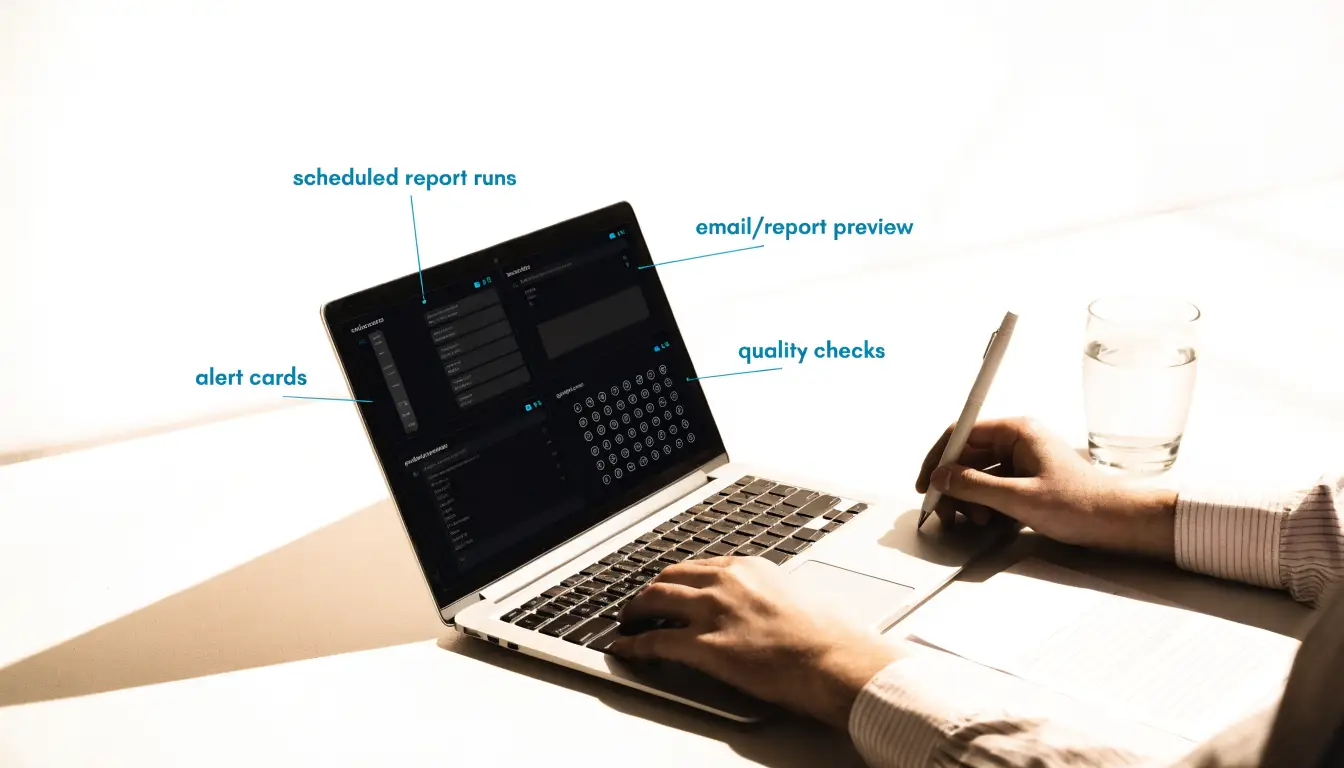
Automated Reporting
The Monday brief, written by the data. Not the analyst.
Recurring reports eat hours that should be spent on the questions they raise. The fix isn't more analysts — it's narrated, scheduled, source-of-truth reports that show up in Slack or the inbox without a human in the loop. Then the analyst gets to the why.
What's inside
Reports the team reads because they're worth reading.
- 01
Måndagsrapporten
Weekly KPI brief in Slack or email — revenue, pipeline, churn, anomalies, the thing that moved. Flagship build. SEK 14 999 ex moms.
- 02
Board pack automation
Monthly board narrative auto-drafted from the data — chart with caption, comparison vs plan, callout for what changed. Editor approves; doesn't author from scratch.
- 03
Sales pipeline digest
Daily or weekly Slack digest: deals progressed, stuck deals, new MQLs, what's at risk this week. Built off the CRM, narrated by an LLM, delivered automatically.
- 04
Custom recurring reports
Whatever the team currently builds by hand every week — operations, support, marketing — turned into a scheduled, narrated artefact.
How an engagement starts
Pick one. Ship in 10 days. Replicate.
- 01
Pick the highest-pain report
Usually Monday morning revenue/pipeline brief, or the weekly board update. We start where the hours are bleeding.
- 02
10-day flagship build
Wired against your warehouse, narrated by an LLM, delivered to Slack or email. Live by end of week two.
- 03
Replicate across the org
Same pattern, new reports. Each subsequent build takes 3–5 days because the infrastructure is already there.
10-day fixed-scope build. SEK 14 999 ex moms. Brief and start.
Common questions
- Where does the narration come from?
- Claude or GPT, with the data passed as structured context. Constrained to factual statements; no editorialising. The voice is yours via a style anchor.
- What if the data's wrong?
- The report is only as clean as the warehouse. If the data has gaps, this surfaces them — which is usually the underrated benefit of building these.
- Slack or email?
- Both. Slack for inline reads, email for the formal pack. Most clients run both — different audiences.
Also under Analytics
Business Intelligence
Dashboards that answer the question. And surface the next one.
Semantic Layer
One definition of every metric. Across teams. Across tools.
Interactive BI
Self-service dashboards the team actually opens.
Agentic Data Intelligence
Agents that watch the metrics. And explain the spike before you ask.